Literature and the Idea of Luxury in Early Modern England by Scott Alison V
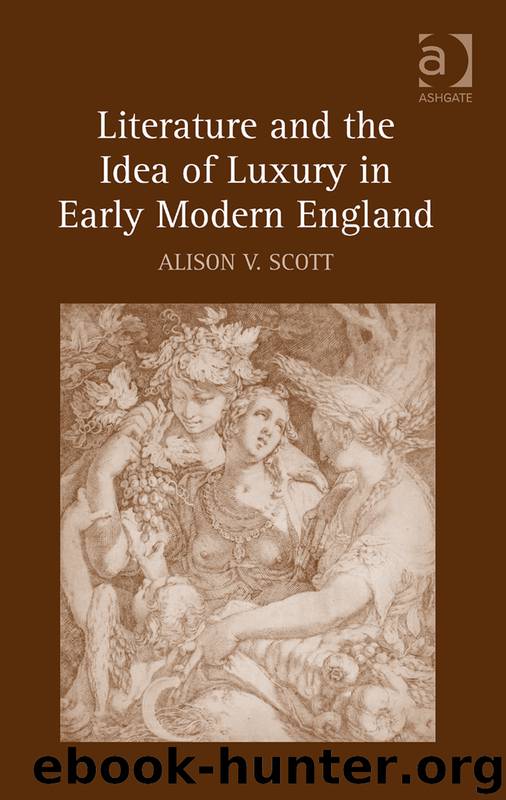
Author:Scott, Alison V.
Language: eng
Format: epub
Publisher: Taylor & Francis (CAM)
Published: 2015-03-12T16:00:00+00:00
Volpone’s Sport
Among Jonson’s comedies, Volpone, with its consideration of what Thomas Greene terms “the infinite, exhilarating and vicious freedom to alter the self at will once the idea of moral constancy has been abandoned” (337), offers an exemplary exploration of imaginative play and self-pleasuring sport as riot. Exploring the “horror of a self too often shifted” (Greene 344), the play examines the ways in which the liquid market – as a version and extension of the theater of puritan critique – enables luxury’s distinctive process of paradoxical decline and proliferation in which constant selves are lost along with fixed values and the certain ownership of the feudal economy. Ownership in Volpone relies both on physical possession – an idea with which it is essentially obsessed – and on narrative, more precisely, personation.33 Ultimately, as the final act of the play testifies, it is not avarice that unfixes the fox, but rather his refusal to be fixed in one role and in “glad possession” of his wealth, a refusal I read as inherently luxurious. Not only does Volpone make a “snare” for his “own neck” and “[o]ut of mere wantonness” run into that snare after narrowly escaping “free and clear” from near disaster (5.11.1–4), but the consequences of that self-abandon are imagined as a bleeding out of the fox’s compromised body, which anticipates his final transformation in the confinement of prison and the consequent mortification of his body for public consumption.34 Together with the parody of stoic constancy in Lady Would-Be’s alchemical pronunciation that “Settling and fixing … Upon one object” overwhelms judgment and “clouds the understanding” (3.4.105–9), Jonson achieves a sophisticated satire of the protean drive to self-transformation presented here as mutually interactive with Venice’s mythic luxury and wealth.35 Playing out the possibilities of luxury as riot, Volpone deconstructs Christian luxury and reconstitutes the idea in the place of the market. Ultimately, and despite its conspicuously moralized conclusion, the play merely stages a denunciation of luxury as sin, using the epilogue to challenge the audience – while they are in the “luxurious” space of the market/theater – to critically re-evaluate what their response to Volpone’s vice/performance will be.
Although Volpone is commonly understood as a comical satire on avarice, less frequently as a satire on the sin of pride, it is more acutely concerned with the fluidity of things, the uncertainties of ownership and the “use of riches” in the shifting contexts of early modern society.36 This preoccupation with perverted relations of person and thing focuses a question about the nature of possession and the extent to which the man possessed of great wealth exercises or is deprived of agency by the objects he “owns”. The aphorism of the First Avocatore – “These possess wealth as sick men possess fevers, / Which trulier may be said to possess them” (5.12.101–2) – is only the most explicit engagement with the problem, but Jonson repeatedly returns to it in more complex ways in this play. Scrutinizing the relation between devilish possession (the suppression
Download
This site does not store any files on its server. We only index and link to content provided by other sites. Please contact the content providers to delete copyright contents if any and email us, we'll remove relevant links or contents immediately.
Still Me by Jojo Moyes(11266)
On the Yard (New York Review Books Classics) by Braly Malcolm(5525)
A Year in the Merde by Stephen Clarke(5430)
Eleanor Oliphant Is Completely Fine by Gail Honeyman(5282)
The Bookshop by Penelope Fitzgerald(3854)
How Music Works by David Byrne(3270)
Surprise Me by Kinsella Sophie(3113)
Pharaoh by Wilbur Smith(2993)
Why I Write by George Orwell(2955)
A Column of Fire by Ken Follett(2613)
Churchill by Paul Johnson(2587)
The Beach by Alex Garland(2562)
The Songlines by Bruce Chatwin(2557)
Aubrey–Maturin 02 - [1803-04] - Post Captain by Patrick O'Brian(2306)
Heartless by Mary Balogh(2259)
Elizabeth by Philippa Jones(2206)
Hitler by Ian Kershaw(2199)
Life of Elizabeth I by Alison Weir(2086)
Harry Potter and the Cursed Child by J. K. Rowling & John Tiffany & Jack Thorne(2066)
